
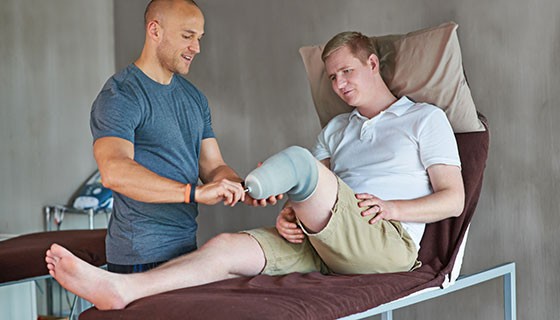
Losing a limb changes a lot, but driving is something most people with a lower limb amputation can return to. With the right vehicle modifications and specialist support, many people drive independently and with few restrictions.
This article explains how the return-to-driving process works after a lower limb amputation in NSW.
Can you drive after a leg amputation?
Yes. Most people with a below-knee or above-knee amputation return to driving. What's involved depends on which leg is affected, whether you drive an automatic or manual vehicle, and whether you use a prosthesis.
Left leg amputation (automatic vehicle). If your left leg is amputated and you drive an automatic, your right leg is your driving leg. In many cases, you can continue driving with minimal or no modifications, since the left leg isn't used for driving in an automatic vehicle. Your doctor and OT will still need to assess your overall fitness to drive, but this is often the most straightforward scenario.
Right leg amputation (automatic vehicle). If your right leg is amputated, you'll need a modification to operate the accelerator with your left foot or your hands. Common options include a left-foot accelerator or hand controls. An OT driving assessment determines which modification is appropriate.
Either leg amputation (manual vehicle). If you drove a manual vehicle, you'll likely need to switch to an automatic (since operating a clutch with a prosthesis or without a leg is generally not safe or practical). This is usually a licence condition rather than a vehicle modification.
Bilateral lower limb amputation. If both legs are amputated, hand controls are typically required, allowing you to brake and accelerate using your hands. This is a more complex setup but many people drive successfully with hand controls.
The return-to-driving process
Step 1: Medical clearance
Your surgeon, rehabilitation physician, or GP needs to confirm you're medically stable and ready to begin the return-to-driving process. This includes your surgical wound being healed, your general health being stable, and (if applicable) your prosthesis being fitted and functional.
They'll complete the Transport for NSW Fitness to Drive form and refer you for an OT driving assessment.
Step 2: OT driving assessment
The OT assesses your physical function as it relates to driving.
The off-road assessment covers your strength, range of motion, coordination, and reaction time in your remaining and prosthetic limbs. The OT will assess your ability to operate vehicle controls (steering, braking, accelerating), your transfer ability (getting in and out of the vehicle), and your overall fitness for the demands of driving.
If you use a prosthesis, the OT will assess how you use it and whether it provides adequate function for driving. Some people drive with their prosthesis, others drive without it (using modifications instead), and the OT helps determine which approach is safest.
The on-road assessment may happen at this stage if modifications are already fitted to a vehicle, or it may be deferred until after modifications are installed and you've had driving lessons.
Step 3: Modification prescription
Based on the assessment, the OT prescribes the specific vehicle modifications you need. For lower limb amputations, common modifications include:
Left-foot accelerator. An accelerator pedal fitted on the left side of the brake, allowing your left foot to control both braking and accelerating. This is the most common modification for right leg amputations.
Hand controls. Push-pull or lever systems that allow you to brake and accelerate using your hands. This is used when foot operation isn't possible or practical (for example, with bilateral amputations or above-knee amputations where prosthetic control isn't reliable enough for driving).
Steering aid. A spinner knob fitted to the steering wheel, allowing one-handed steering. This is often used in combination with hand controls, since one hand operates the controls and the other steers.
Pedal guard. A guard fitted over the standard accelerator pedal when a left-foot accelerator is installed, to prevent accidental use of the original pedal.
Step 4: Driving lessons
Once modifications are fitted, you'll have lessons with a rehabilitation driving instructor to learn to use the new setup. Even experienced drivers need time to adjust to modified controls.
The number of lessons varies. For a straightforward left-foot accelerator, some people are comfortable after just a few sessions. Hand controls typically take longer to master.
Step 5: OT reassessment and disability driving test
The OT reassesses your driving with the modifications in place. If Transport for NSW requires it (which they will for major control modifications like hand controls or a left-foot accelerator), you'll also need to pass a disability driving test at a Service NSW centre in your modified vehicle.
Step 6: Licence conditions
Your licence is updated with conditions specifying the modifications you must drive with (for example, "automatic vehicle with left-foot accelerator" or "must use hand controls and steering aid").
Driving with a prosthesis vs without
This is an individual decision made with your OT. Some considerations:
Driving with a prosthesis can work well, particularly for below-knee amputations where the prosthesis provides good ankle and foot control. The advantage is that you may not need vehicle modifications (particularly for left leg amputations in automatic vehicles). The OT will assess whether your prosthetic control is reliable and safe enough for driving.
Driving without a prosthesis (using vehicle modifications instead) is often preferred when prosthetic control isn't reliable enough for the precision needed for braking and accelerating, or when fatigue or discomfort from the prosthesis could affect driving performance.
There's no single right answer. The OT assessment determines what's safest for you.
Funding
Several funding pathways are commonly available for driving rehabilitation after amputation.
iCare. If your amputation resulted from a motor vehicle accident or workplace accident in NSW, iCare typically funds the full process: OT assessment, vehicle modifications, driving lessons, and ongoing maintenance.
DVA. For eligible Department of Veterans' Affairs cardholders, modifications and the assessment process may be funded through DVA.
NDIS. For eligible participants with a plan-managed or self-managed plan, the assessment, modifications, and lessons can be funded through NDIS.
Private payment. Available if no funded pathway applies.
Your case manager, rehabilitation coordinator, or GP can help navigate the funding options.
How long does the process take?
From initial OT assessment to driving independently, the timeline typically ranges from a few weeks (for straightforward cases like a left leg amputation with no modifications needed) to several months (for more complex cases requiring hand controls, modification installation, lessons, and a disability driving test).
The main variables are equipment availability, funding approval timelines, and how many driving lessons you need.
Starting the process
If you've had a lower limb amputation and you're ready to get back on the road, the first step is a referral from your surgeon, rehabilitation physician, or GP. They'll complete the Transport for NSW Fitness to Drive form and refer you for an OT driving assessment.
You can start the process at steerdriving.com.au/referral.
Ready to book an OT driving assessment in Sydney? Steer Driving is a mobile assessment service covering greater Sydney. Whether you already have a referral or you're just getting started, get in touch and we'll guide you through the next steps.
This article was written by Elise, an AHPRA-registered Occupational Therapist and Transport for NSW-registered driver assessor. Elise is the founder of Steer Driving, a mobile OT driving assessment practice in Sydney.
FAQ Section
Can you drive after a leg amputation? Yes. Most people with a lower limb amputation return to driving, often with vehicle modifications such as a left-foot accelerator or hand controls. An OT driving assessment determines what's needed for your specific situation.
What vehicle modifications are used after a lower limb amputation? Common modifications include a left-foot accelerator (for right leg amputations), hand controls (for bilateral or more complex amputations), steering aids, and pedal guards. The OT prescribes the right modifications based on your assessment.
Can I drive with a prosthetic leg? Some people can, depending on the level of amputation and how well the prosthesis functions for the precision needed for driving. Your OT will assess this as part of the driving assessment.
Does iCare fund driving modifications after an amputation? If your amputation resulted from a motor vehicle accident or workplace accident in NSW, iCare typically funds the full return-to-driving process including the OT assessment, vehicle modifications, and driving lessons.
Do I need a special driving test after getting vehicle modifications? If your modifications change how you operate the vehicle's major controls, Transport for NSW requires a disability driving test in your modified vehicle. Your OT will coordinate this.
How long does it take to get back to driving after an amputation? It varies. Straightforward cases (left leg amputation, automatic vehicle, no modifications needed) can be resolved in weeks. More complex cases requiring modifications, lessons, and a disability driving test may take several months.