
If you have been told you need vehicle modifications to keep driving, the hardest part is usually not the equipment. It is working out the order things happen in, who signs off on what, and who pays.
This guide sets that out plainly for Queensland.
Who needs modifications?
Modifications are for people whose body cannot operate a standard car safely, but who can still drive well with the right setup. That includes people with:
Spinal cord injury
Amputation
Stroke affecting one side
Multiple sclerosis, motor neurone disease and other neurological conditions
Cerebral palsy or spina bifida
Arthritis, joint replacements or reduced strength
Limited neck rotation
Modifications are about the body, not about thinking or memory. If the concern is memory, attention or judgement, modifications will not help and the assessment goes a different way.
What modifications are available?
Instead of the pedals
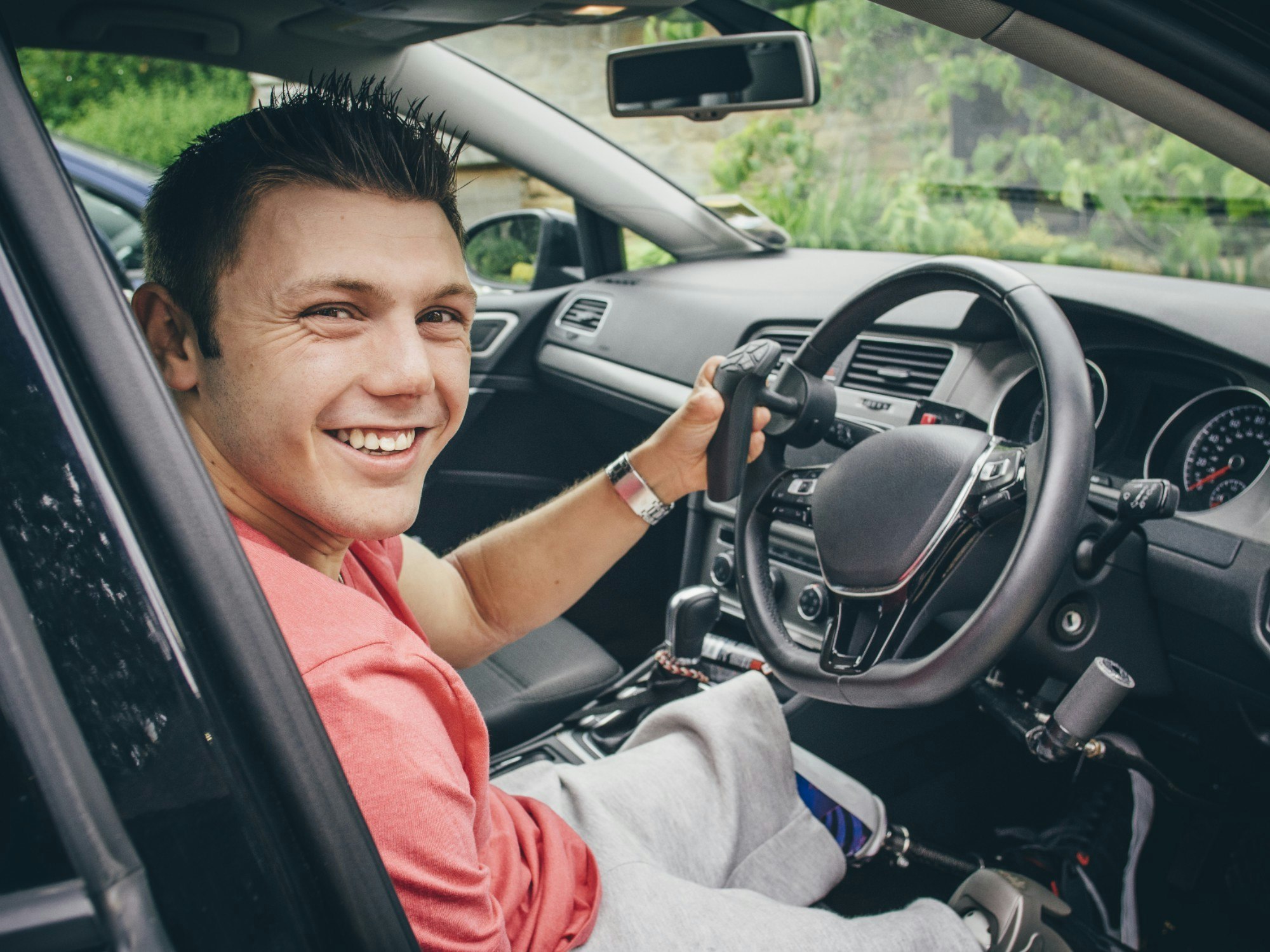
Hand controls. A lever near the steering wheel that operates the accelerator and brake. Mechanical push-pull controls are the most common. Electronic controls need less force and suit people with limited arm strength.
Left foot accelerator. A second accelerator pedal on the left, for people who cannot use their right leg.
Pedal extensions. For shorter drivers who otherwise sit too close to the airbag.
For steering
Steering knob, tri-pin or palm grip. Lets you steer accurately with one hand while the other operates the hand control.
Reduced effort steering. The car is modified so the wheel needs far less force to turn.
For the switches
Remote control panels so you can reach indicators, wipers, lights and horn without letting go of the wheel or the hand control.
Electronic parking brake conversions.
For getting in and out
Swivel seats, transfer boards, grab handles
Person hoists
Wheelchair loaders and hoists for stowing a chair
Wheelchair accessible vehicle conversions
For seeing better
Additional mirrors, including blind spot and panoramic mirrors, which are often the answer for reduced neck movement
Why does the OT assessment come first?
Because a modification is a prescription, not a purchase.
Two people with what looks like the same condition often need different equipment. The right hand control depends on your shoulder strength, your grip, your trunk stability, your car and how far you drive. Choosing wrongly means either equipment you cannot use, or equipment that is unsafe.
There is a practical reason too. Funders will not pay for modifications without a report from an occupational therapist setting out what is needed and why. Nor will most modifiers fit disability controls without one.
In Queensland, TMR expects decisions about disability modifications to be made jointly by the driver, the certified modifier (called an Approved Person) and a qualified occupational therapist.
The other reason to be assessed first is money. People regularly buy a car and then find it cannot take the controls they need. Get assessed, then buy.
What happens in the assessment?
Off road. I come to you. We look at strength, grip, range of movement, sitting balance, reaction time and how you currently get in and out of a vehicle. We also talk through what you actually need to do, such as school runs, long drives, carrying a wheelchair or working.
On road. You drive a car fitted with trial equipment, with a specialist driving instructor beside you. This is the part that decides things. Equipment that feels fine parked in a driveway can feel completely different in traffic, and it is common to try more than one option.
The report. I write up the specific equipment recommended, item by item, with the clinical reason for each. That is the document your funder and your modifier work from.
See What Is an OT Driving Assessment.
How does approval work in Queensland?
Vehicle modifications in Queensland are governed by the Queensland Code of Practice: Vehicle Modifications. The codes covering disability controls are LC3 (design) and LC4 (modification).
Standard modifications are fitted by an Approved Person, who certifies the work. Modifications that fall outside the codes need individual approval from TMR, applied for using Form F1854.
Once you are driving a modified vehicle, TMR records a code on your licence. It means you drive vehicles set up that way. If you later change your equipment, your licence needs updating.
TMR's information is at Vehicle modifications.
Who pays?
NDIS. Funds assessments, modifications and driving lessons where it is in your plan and you are under 65. Steer Driving works with self-managed and plan-managed participants.
CTP insurance. For injuries from a Queensland motor vehicle crash.
NIISQ. For very serious crash injuries in Queensland, regardless of fault.
WorkCover Queensland. For workplace injuries.
DVA. For eligible veterans.
iCare (NSW). If your injury happened in New South Wales. See iCare and OT Driving Assessments.
Private. Many older drivers who need mirrors or a steering knob simply pay for the assessment themselves, as the equipment is inexpensive.
See How Much Does an OT Driving Assessment Cost in Queensland.
What is the order of events?
Referral, usually from your GP, specialist, rehab team or support coordinator
OT driving assessment, on and off road
Report with equipment recommendations
Quote from an Approved Person
Funding submitted and approved
Modifications fitted and certified
Driving lessons in the modified vehicle
Final on-road check and report
TMR updates your licence code
Simple modifications such as mirrors or a steering knob can move through this in a few weeks. Hand controls typically take a few months, mostly waiting on funding. Wheelchair accessible vehicle conversions can take the better part of a year.
Common questions
Can I just buy hand controls online and fit them myself? No. Disability driving controls must be fitted and certified by an Approved Person. Uncertified modifications can make your vehicle unroadworthy and affect your insurance.
Will modifications stop me driving other cars? Yes, in practice. Your licence will carry a code limiting you to appropriately modified vehicles.
Do I have to buy a new car? Not necessarily. Many existing cars can be modified. Automatic transmission is generally needed, and some models are much easier to work with than others.
Are hand controls hard to learn? They take practice, but most people adapt within a handful of lessons. It is a new habit rather than a new skill.
Can I get modifications if I have never held a licence? Yes. Learner drivers can be assessed and modifications prescribed. See Learning to Drive with a Disability on the Gold Coast.
Do I need a doctor's referral? Not always, but it helps, particularly where TMR has already asked for a medical review. You can start the process at steerdriving.com.au/referral.
Ready to book an OT driving assessment on the Gold Coast? Steer Driving is a mobile assessment service covering the Gold Coast and surrounding areas. Whether you already have a referral or you're just getting started, get in touch and we'll guide you through the next steps.
This article was written by Elise, an AHPRA-registered Occupational Therapist and driver assessor. Elise is the founder of Steer Driving, a mobile OT driving assessment practice.
References
Queensland Government. (2021). Queensland code of practice: Vehicle modifications. Department of Transport and Main Roads. https://www.publications.qld.gov.au/dataset/queensland-code-of-practice-vehicle-modifications-qcop
Queensland Government. (2024). Vehicle modifications. Department of Transport and Main Roads. https://www.tmr.qld.gov.au/safety/vehicle-standards-and-safety/vehicle-modifications